
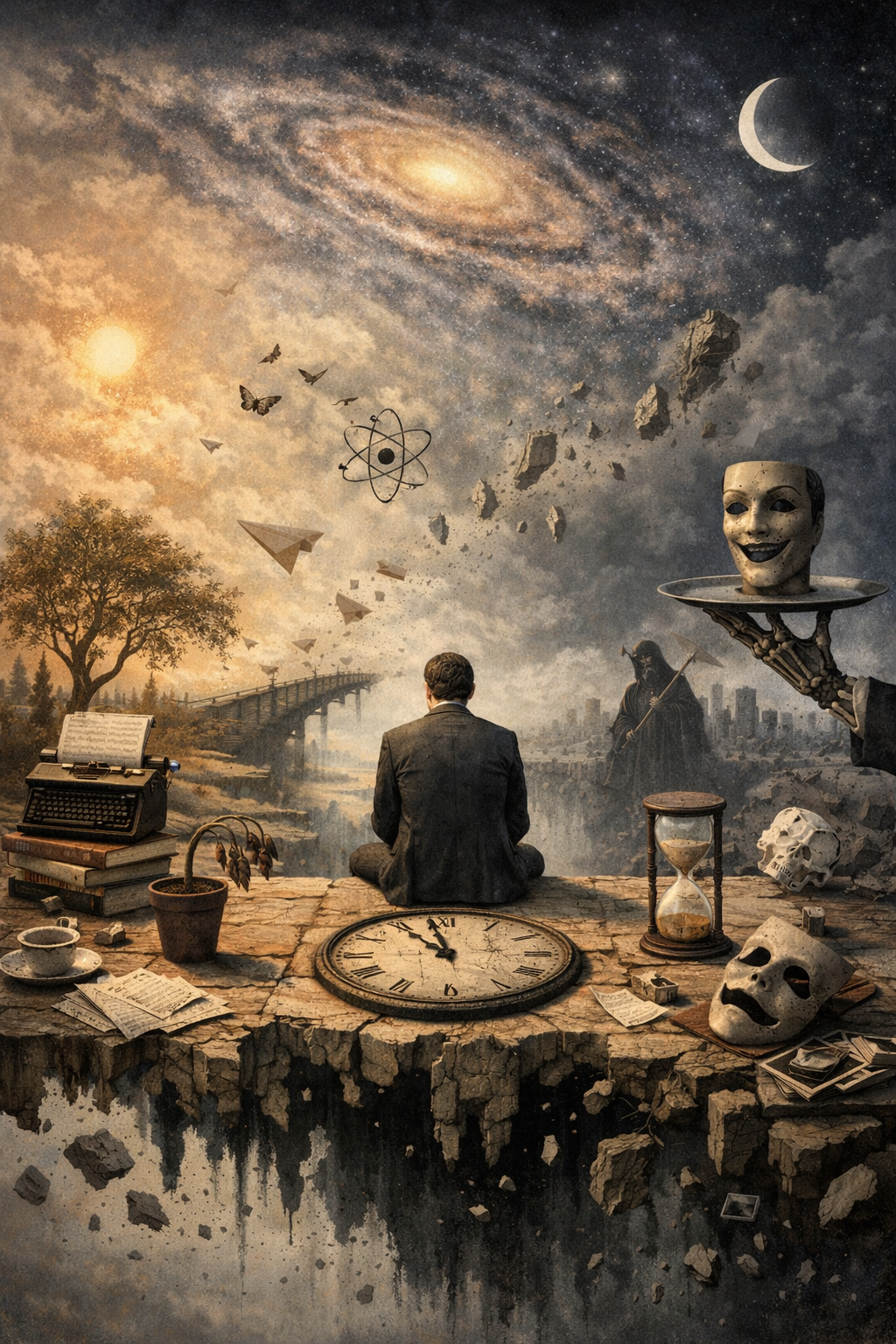
Try to be at ease. Or at least appear so convincingly that even you begin to believe it.
Move through your days as if they were gifts, though you were never asked whether you wanted them. Call this gratitude. It helps.
Learn to admire things. Sunlight on walls, the geometry of leaves, the accidental kindness in a stranger’s voice. Tell yourself this is meaning. It is, in a way—just not the kind that answers anything.
If possible, love. Or rehearse love until it resembles the real thing. Attach yourself gently to people, to moments, to small patterns of beauty. It gives structure to the drift.
And yet—try not to look too closely.
Because beneath the surface, life remains what it has always been: a brief and fragile interruption. You arrived without consent, and you will leave without negotiation. In the meantime, you inhabit a body that is not entirely yours—an ecosystem of borrowed matter, inhabited, sustained, and quietly consumed by other forms of life. You call it “self” for convenience.
You think, and this is where it becomes difficult.
Because to be conscious is to stand exposed. To be aware is to feel the edges of things: time passing, meaning slipping, certainty dissolving. The mind does not protect—it reveals. And what it reveals is not always bearable.
Still, we persist. We organize the chaos. We name things, build systems, write philosophies, compose music—small acts of defiance against a silence that does not answer back.
Perhaps the universe is ordered. Perhaps it is not. Perhaps everything is determined long before we arrive. Or perhaps it is simply indifferent, unfolding without intention, without witness, without care.
Either way, we are here—briefly.
A moment of light, aware of itself, suspended between two immensities of nothing.
And for reasons that remain unclear, we call this existence.
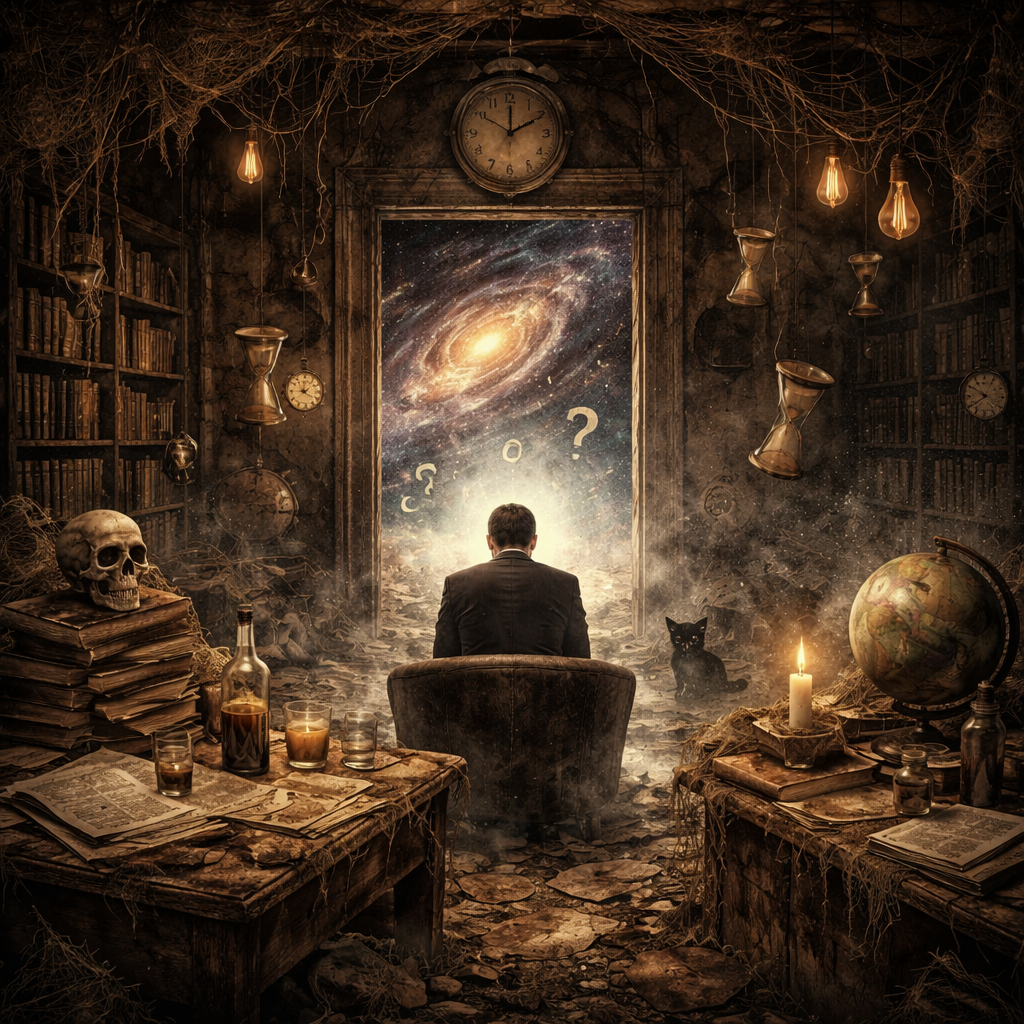
You may proceed as if things matter. It keeps the structure intact.
Wake, arrange your face into something socially acceptable, and step once more into the agreement we all silently uphold—that this is meaningful, that this is going somewhere, that we are not merely passing time inside a beautifully decorated uncertainty.
Call your routines “purpose.”
Call your attachments “love.”
Call your persistence “strength.”
Language is generous like that. It allows us to survive our own clarity.
Notice how easily the mind builds small sanctuaries—ideas, beliefs, ambitions. Rooms with warm lighting where the larger questions are politely not invited. You may stay there as long as you like. Most do. It is considered healthy.
But sometimes the walls thin.
And then it becomes difficult not to notice that existence is strangely unconsulted. You are here, undeniably, yet without origin in your own will. Installed into a body already in progress, into a history already unfolding, into a world that neither asked for you nor needs you.
Still, you develop preferences. This is the charming part.
You prefer warmth to cold, recognition to indifference, continuity to disappearance. You construct a self—a delicate narrative threaded through memory, habit, and expectation—and defend it as if it were something stable, something owned.
Meanwhile, the body replaces itself cell by cell.
The mind revises itself thought by thought.
Even your convictions quietly expire and renew without formal announcement.
Identity persists mostly out of politeness.
And yet, consciousness remains—this peculiar brightness that does not belong anywhere. It observes, records, anticipates, regrets. It stretches across time just enough to feel its own limits. Enough to understand that everything it touches dissolves.
This is not tragedy, exactly. It is more refined than that.
It is the subtle discomfort of being present in a reality that does not explain itself. A universe that functions impeccably without ever justifying its existence. A system of astonishing precision that produces, among other things, you—capable of asking why, but not equipped to receive an answer.
So you adapt.
You cultivate interests. You develop taste. You refine your distractions until they resemble meaning. You learn to laugh—not because it resolves anything, but because it softens the edges of awareness.
And occasionally, in quieter moments, you sense it again:
That everything you are is temporary.
That everything you know is partial.
That everything you hope for is negotiated against time.
A brief coherence in a vast indifference.
Still, you continue. Of course you do.
There is something almost elegant in that—
this insistence on existing,
even when existence declines to explain itself.
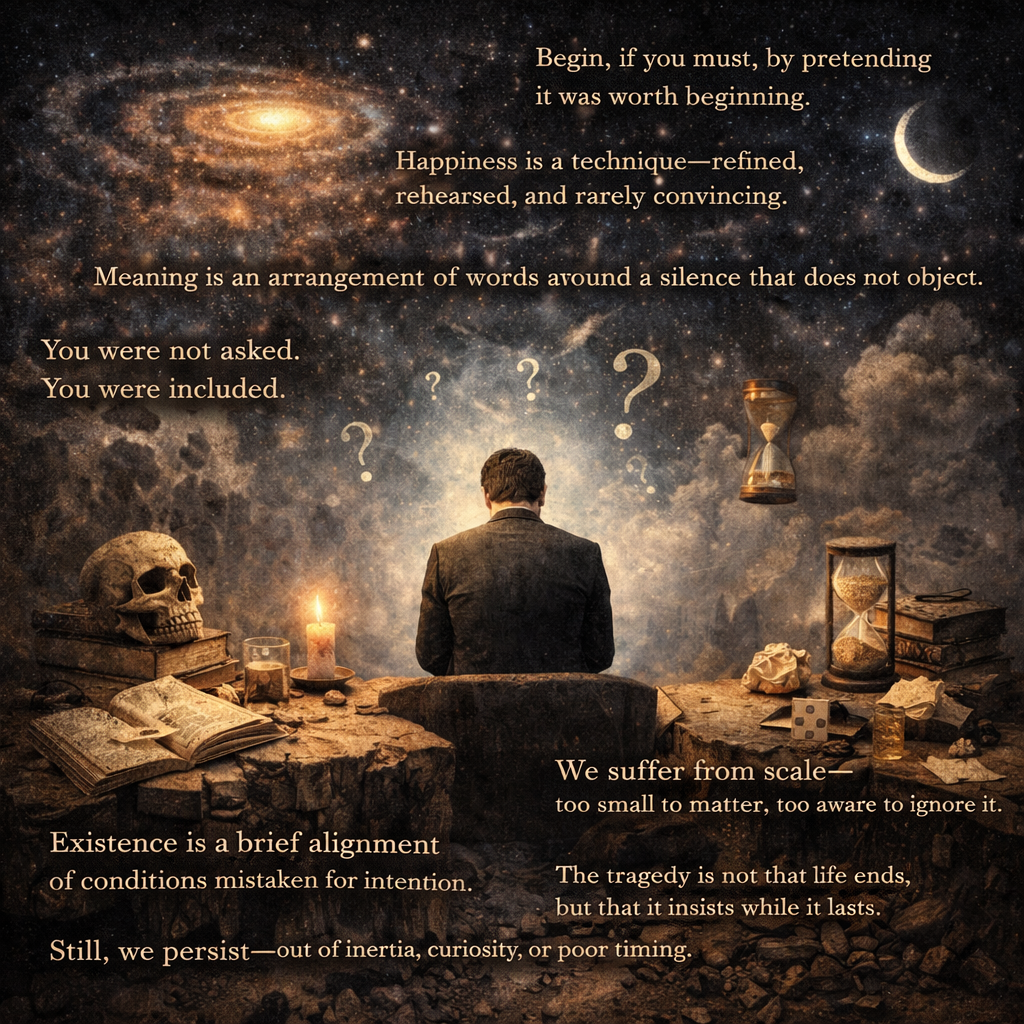
Begin, if you must, by pretending it was worth beginning.
Happiness is a technique—refined, rehearsed, and rarely convincing.
Meaning is an arrangement of words around a silence that does not object.
You were not asked.
You were included.
The body insists on itself—hunger, fatigue, desire—
as if urgency could substitute for purpose.
We call it “life,”
as one names a room to avoid noticing it has no exit.
Every conviction is a temporary shelter.
Every shelter leaks.
To think is to disturb the surface.
To understand is to lose interest in the answers.
Consciousness: a light that reveals too much and explains nothing.
We decorate time so it does not resemble waiting.
We call this activity.
Identity is continuity by habit.
Remove memory, and the self politely dissolves.
Hope is the most elegant delay of clarity.
Death is not an event but a correction—
a quiet refusal of the claim that this mattered.
The universe does not oppose us.
It simply declines to notice.
We suffer from scale—
too small to matter, too aware to ignore it.
Existence is a brief alignment of conditions
mistaken for intention.
The tragedy is not that life ends,
but that it insists while it lasts.
Still, we persist—
out of inertia, curiosity, or poor timing.
A flicker calling itself a flame,
in a darkness that never asked for light.
On Time
Time does not pass.
It accumulates inside you.
Clocks are polite fictions—
they measure motion, not loss.
The past is not behind you.
It is layered within, quietly rewriting what it means to have been.
The future is a rumor the present tells itself
to remain tolerable.
You do not move through time.
Time rearranges you.
On Identity
You introduce yourself as if continuity were obvious.
But what exactly persists?
A name? A memory? A preference repeated often enough to feel essential?
Remove yesterday, and today loses its author.
Remove tomorrow, and intention collapses into gesture.
The self is not a thing.
It is an agreement between fragments.
And even that agreement expires nightly.
On Knowledge
To know is not to possess truth,
but to narrow the field of what can still surprise you.
Certainty is a local phenomenon—
useful, temporary, and deeply suspicious.
Every answer refines the question it cannot eliminate.
The more precise your understanding,
the less stable your conclusions.
Ignorance is vast.
Knowledge is its most elegant disguise.
On Freedom
You feel free because you do not perceive the constraints in real time.
Choice arrives already shaped—
framed by biology, language, history, and accident.
You select among options you did not design,
desire outcomes you did not invent,
regret paths you could not fully see.
Freedom is not the absence of limits.
It is the choreography of them.
You move well within a structure
you did not choose to enter.
On Reality
Reality does not present itself.
It is inferred.
What you call “world” is a translation—
compressed, filtered, stabilized for survival.
You do not perceive what is.
You perceive what can be tolerated.
The universe remains largely uninterpreted—
not because it hides,
but because there is no obligation to reveal.
Truth is not concealed.
It is simply not formatted for you.
On Death
Death is not the opposite of life.
It is its boundary condition.
It does not arrive;
it has always been present—
quietly structuring every moment you call “now.”
You do not move toward death.
You unfold within it.
What ends is not existence,
but your version of it.
And even that was provisional.
On Meaning
Meaning is not discovered.
It is installed.
A function of perspective,
maintained by attention,
fragile under scrutiny.
Ask long enough, and it begins to thin.
Not into despair—
but into something cleaner:
A recognition that the universe proceeds
without narrative.
Meaning is what consciousness adds
to avoid experiencing this directly.
On Consciousness
Consciousness is not a gift.
It is an exposure.
To be aware is to be unable to fully belong.
You are both inside the world
and displaced from it—
observing, interpreting, never entirely merging.
It illuminates everything
except its own origin.
A light that cannot see its source,
yet insists on shining.
On Existence
Existence is not a problem to solve.
It is a condition to endure.
A temporary coherence
in an indifferent field.
You appear, stabilize briefly,
generate significance,
and dissolve.
Nothing in this sequence requires justification.
Only your awareness of it does.
And that awareness—
precise, restless, unresolved—
is what you call being.
Coda
The question is not why there is something rather than nothing.
The question is why something—
having appeared—
finds itself compelled
to ask.
By Vladimir Butkov