
Plato famously described time as a “moving image of eternity.” Yet both eternity and infinity are abstractions of thought, while motion itself belongs to the fabric of reality. Motion is not merely imagined; it is experienced, measured, and manifested throughout the universe.
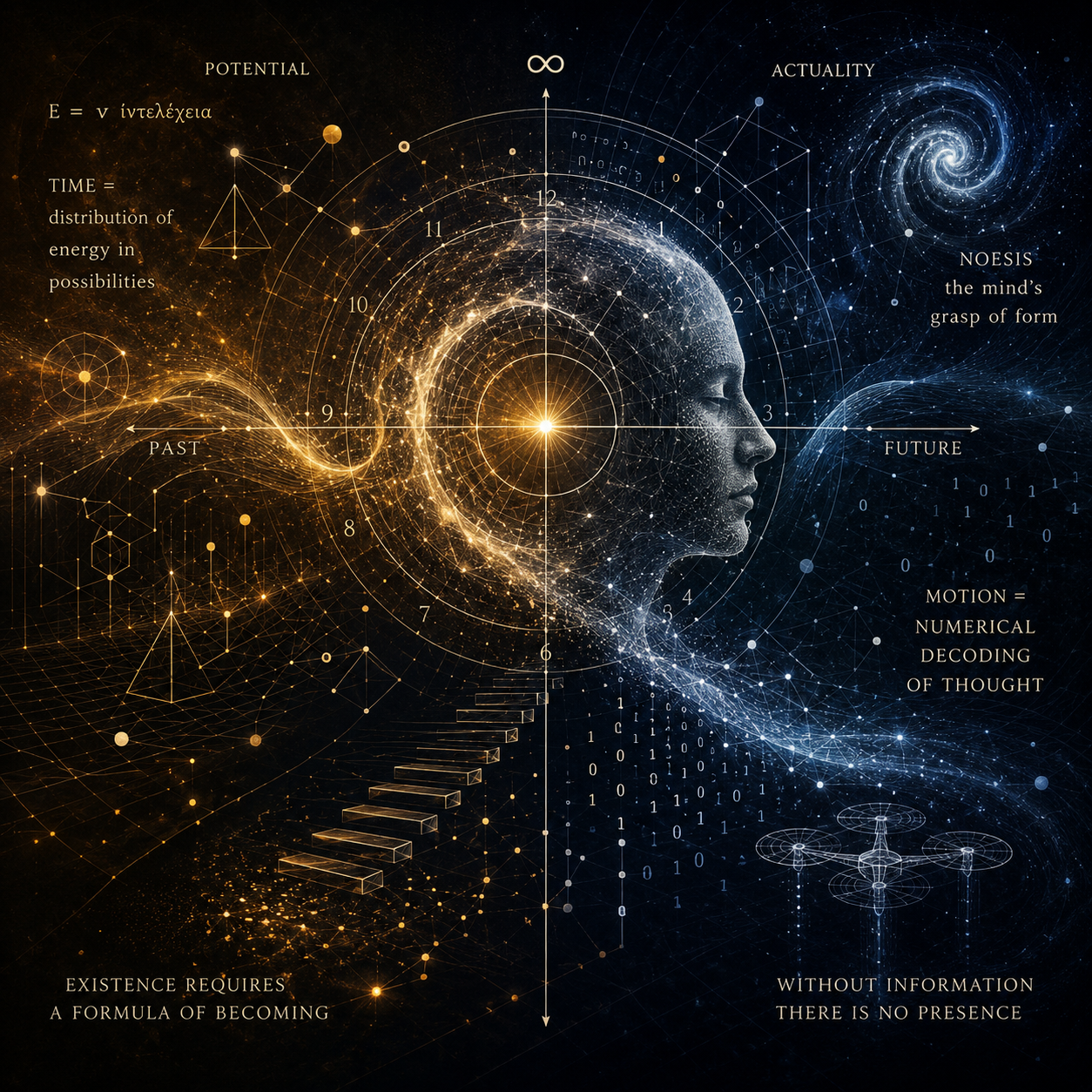
Aristotle defined motion as the actuality of what exists in potentiality—the realization of possibility through energy. If we follow this insight, time can be understood not as a container in which events occur, but as the distribution of potentiality into actuality. Time is the ordering principle through which possibilities become realities. In this sense, time resembles a formula rather than a substance—a dynamic algorithm governing transformation. Many physicists would find this interpretation familiar, for modern physics increasingly describes reality through mathematical structures rather than material essences.
Yet motion is not simply an expression of time, nor can time be reduced to motion alone. Time appears to be something deeper: a fundamental principle that enables both change and intelligibility.
The ancient Greeks often associated the deepest structures of reality with Nous (Mind) or Logos (Reason). Noesis, the act of intellectual apprehension, was understood as the mind’s direct grasp of a form. In such an event, the knower and the known become united. The mind does not merely observe a form; it temporarily becomes the intelligible structure of that form.
From this perspective, the movement of a thing and the activity of thought are not entirely separate processes. The energy that unfolds a phenomenon and the energy through which it is understood may be different expressions of the same underlying reality. Every act of understanding is itself an event, and every event can be interpreted as the unfolding of information.
To perceive motion, the mind must detect difference. Difference appears as succession: one state followed by another. This succession is recognized through number, through counting, through the distinction between “before” and “after,” ultimately arriving at what we call “now.” Motion therefore becomes a kind of numerical decoding of reality—a translation of continuous becoming into intelligible structure.
Aristotle observed that number emerges when continuity is interrupted by distinction. Modern physics echoes this insight in surprising ways. Theories involving quantum discreteness and Planck-scale structure suggest that space-time itself may not be perfectly continuous. Reality may be composed of distinguishable informational states whose transitions generate the appearance of motion and change.
Within the Infinous framework, every entity possesses an intrinsic pattern of transformation—a formula of becoming. A thing exists not merely because it occupies a location in space, but because it contains within itself the informational logic that determines how it may evolve from one moment to the next. Existence requires continuity of self-transformation.
A useful analogy is a drone connected to its navigation system. As long as it continuously receives and processes the information necessary to determine its next state, it remains present within the operational world. If that informational continuity is completely lost, the drone no longer knows where it is or where it should go. It effectively disappears from the system that defines its existence.
Likewise, every object, organism, mind, and civilization persists because it carries a self-consistent map of its own becoming. Time is not merely the sequence through which events pass. Time is the informational principle that allows reality to calculate its next state.
In this view, time is neither a flowing river nor an independent dimension. It is the universe’s mechanism of self-computation—the process through which possibility continuously transforms itself into actuality. The future is not waiting somewhere ahead of us. Rather, it is being generated, moment by moment, through the ongoing decoding of existence itself.
By Vladimir Butkov