
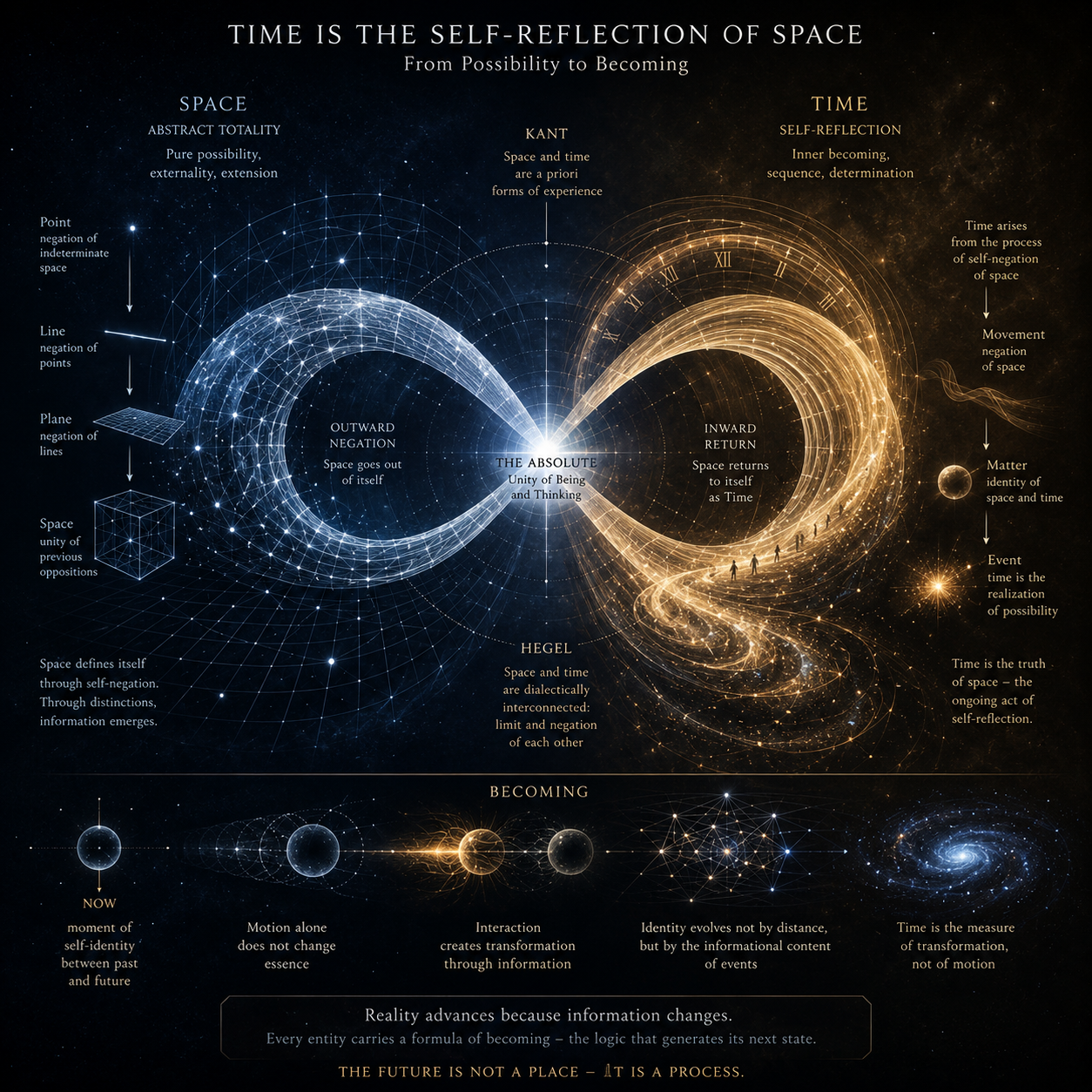
Immanuel Kant argued that space and time are not properties of the external world itself but a priori structures of perception. Time, for Kant, is the framework of inner experience—the invisible architecture that makes thought, memory, and understanding possible. We do not discover time in reality; rather, reality becomes intelligible to us through time.
Yet Kant’s insight may be extended beyond human subjectivity. Space and time need not be merely conditions of rationality; they may be the very origins of rationality itself. The universe may possess a primitive form of self-ordering logic embedded within its structure. Rationality, in this broader sense, is not something imposed upon reality by observers. It is something that reality already contains in embryonic form.
This possibility became increasingly visible in the tradition of German Idealism, reaching its most ambitious expression in the philosophy of Hegel.
For Hegel, space and time are not independent entities. They exist in a dialectical relationship, continuously generating and negating one another. Space seeks determination, while time is the process through which that determination unfolds. Their tension produces movement; their temporary reconciliation produces matter.
Hegel suggested that time becomes meaningful only through its relation to space. A universe containing pure time without spatial differentiation would possess no events, no structure, and no content. Time gains significance only when something changes, and change requires distinctions that emerge through spatial relations.
Nature, in Hegel’s philosophy, is the external manifestation of the Absolute—the universal principle seeking self-understanding. Space is the first expression of this externalization. It is pure extension, pure possibility, the abstract field within which nature begins to define itself.
Yet space contains an inner contradiction. It appears continuous, but it can only become intelligible through distinctions. A point negates undifferentiated space. A line negates the isolation of points. A surface negates the limitation of lines. Higher forms emerge through successive acts of determination. Reality acquires structure through a sequence of self-negations that transform pure possibility into concrete existence.
In modern language, one might say that information emerges through symmetry breaking. Every distinction creates information. Every act of determination reduces uncertainty and increases structure.
Time arises from this process.
In a profound sense, time can be understood as space becoming aware of itself. It is space entering into a relationship with its own structure. Time is not merely another dimension alongside spatial dimensions. It is the record of space continuously reorganizing itself.
Hegel called time the truth of space. From an Infinous perspective, we may reinterpret this statement as follows: time is the informational self-reflection of spatial reality.
The universe does not simply exist in time. Rather, time emerges whenever reality computes its next state.
This insight leads to a remarkable cosmological possibility.
If space contains within itself the capacity for self-negation and self-transformation, then the birth of a universe may not be a unique event. The Big Bang may represent only one instance of a deeper process through which spatial reality repeatedly transcends its own limitations.
Every universe could emerge from a distinct act of spatial self-organization, producing different physical laws, different constants, and different histories. The multiverse would then not be a collection of random worlds but a vast landscape of alternative solutions generated by space repeatedly redefining itself.
What modern cosmology calls dark energy may even represent a residual manifestation of this deeper process—the continual tendency of reality to move beyond its current form.
Time, therefore, is more than a measure of duration. It is the signature of becoming.
We normally think of time as a registration of motion. A moving object occupies different positions, and time records this sequence. Yet the true transformation of a thing does not arise simply because it travels through space.
A stone moved from one location to another remains essentially the same stone.
A mind, however, can be profoundly transformed without moving at all.
What changes the identity of a thing is not distance but interaction. A thing becomes different through its encounters, relationships, exchanges of information, and participation in events.
The “now” accompanies every object as a point of temporary self-identity between its remembered past and its possible future. Yet this self-identity is never absolute. Every interaction modifies it.
For this reason, the evolution of a thing is not proportional to the distance it travels but to the informational content of the events it experiences.
A civilization that remains physically stationary may undergo enormous temporal transformation. A particle crossing vast distances through empty space may experience almost none.
From the perspective of Infinous, time is not fundamentally the measure of motion. It is the measure of transformation.
The deeper flow of time is therefore not measured in seconds but in becoming. Reality advances because information changes. Existence persists because every entity carries within itself a formula of becoming—a dynamic logic that allows it to generate its next state.
Time is the universal process through which this computation unfolds.
The future is not waiting ahead of us.
It is being continuously created by reality’s ongoing act of self-interpretation.
Time is the informational self-reflection of space, while becoming is driven not by motion itself, but by the accumulation of interactions and transformations.
By Vladimir Butkov